
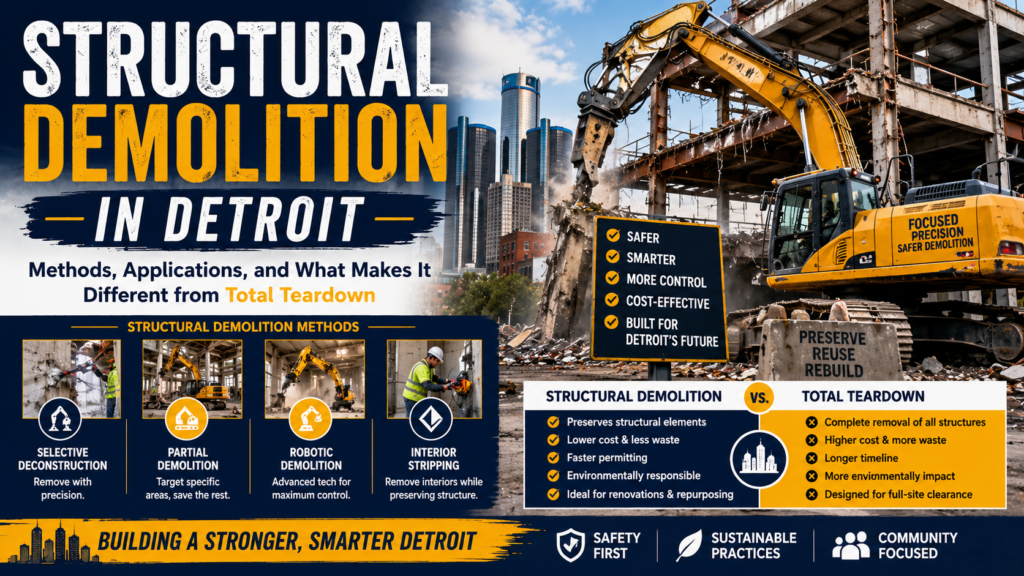
Not all demolition means tearing everything down. Structural demolition is a specialized discipline that encompasses a wide range of operations, from the complete removal of large load-bearing systems to the precise selective deconstruction of specific building components while preserving everything else. In Detroit, a city with an enormous and diverse building stock spanning more than a century of construction styles, structural demolition is a daily reality on both residential and commercial projects. Understanding what Structural Demolition Detroit actually involves, which methods are used and why, and what distinguishes it from general teardown, is useful knowledge for any property owner, developer, or project manager operating in Detroit.
Defining Structural Demolition
Structural demolition refers specifically to the removal or deconstruction of load-bearing and structural elements of a building. These are the components that carry the weight of the structure, distribute loads to the foundation, and provide the building’s fundamental stability. Structural elements include foundation walls, bearing walls, columns, beams, floor systems, and roof structures. When these components are targeted for removal, whether in whole or in part, the work requires engineering oversight, careful sequencing, and methods that prevent uncontrolled collapse or damage to adjacent structures.
This distinguishes structural demolition from general or interior demolition, which typically involves removing non-structural elements such as partition walls, ceilings, flooring, mechanical systems, and architectural finishes. Interior demolition can be performed without the same level of structural engineering involvement, though it still requires professional execution and, in most cases, permits from the City of Detroit BSEED.
Types of Structural Demolition Work in Detroit
Complete Structural Demolition
Complete structural demolition involves the total removal of all structural systems, including the foundation. This is the most comprehensive form of demolition and is used when a site is being fully cleared for new development, when a structure has deteriorated beyond repair, or when a building must be removed to make way for an entirely different land use. In Detroit, complete structural demolition has been carried out at scale through the city’s blight removal programs, as well as by private developers clearing sites for new construction across commercial and residential neighborhoods.
Selective Structural Demolition
Selective structural demolition is among the most technically demanding forms of demolition work. It involves removing specific structural elements from a building while leaving the overall structure intact and stable. This type of work is required during renovation projects where load-bearing walls are being removed to create open floor plans, when structural systems are being reconfigured as part of building conversion, or when damaged structural members need to be extracted and replaced without bringing down surrounding portions of the building.
Selective structural demolition requires careful planning, often with input from a structural engineer who assesses load paths and determines what temporary shoring, bracing, or support structures are needed to maintain stability during the removal operation. The work is performed with precision tools and controlled methods rather than large mechanical equipment.
Partial Structural Demolition
Partial structural demolition involves removing an entire section or wing of a building, such as a rear addition, a floor level, or a damaged portion of the structure, while preserving the remainder. This approach is used in adaptive reuse projects where a building is being reduced in scale, in situations where one portion of a structure has been damaged by fire or other events while adjacent sections remain sound, or in phased redevelopment where part of a complex is removed while another part continues operating.
Structural Demolition Methods Used in Detroit
The choice of demolition method depends on the type of structure, its location, the surrounding environment, and the specific structural elements being targeted.
Mechanical Demolition
Mechanical demolition uses heavy equipment, primarily hydraulic excavators with various attachments, to break down structural elements. Hydraulic breakers are used for concrete. Concrete pulverizers crush and separate reinforced concrete from embedded steel. Steel shears cut structural steel members. Mechanical demolition is the most common method for complete structural teardown of residential and low-rise commercial structures in Detroit. It is fast, efficient, and highly capable on projects where precision control is less critical than throughput.
Manual and Hand-Tool Demolition
For selective and precision structural work, manual methods using hand tools, reciprocating saws, angle grinders, concrete saws, and similar equipment are necessary. This approach allows contractors to work within tight tolerances, removing only what needs to be removed while protecting adjacent structural components. It is slower than mechanical demolition but essential for complex renovation projects in occupied or partially occupied buildings.
Robotic Demolition
Robotic demolition uses remote-controlled compact demolition robots equipped with hydraulic attachments to perform structural work in confined spaces, at heights, or in environments that would be hazardous for human operators. These machines can work indoors, in tunnels, or in basements where large equipment cannot access. In Detroit’s older industrial and commercial building stock, where interior structural work often involves confined and complex environments, robotic demolition is an increasingly relevant tool.
Controlled Implosion
For large structures such as high-rise buildings, industrial facilities, or major commercial complexes, controlled implosion using precisely placed and timed explosive charges can bring down an entire structure in seconds. This method requires extensive engineering analysis, regulatory approval, and safety protocols, but can be highly efficient for structures too large for mechanical methods alone. Detroit’s industrial heritage means this technique has been applied periodically to large structures in the region.
Shoring and Temporary Support in Structural Demolition
One of the most important, and often invisible, aspects of structural demolition is the use of temporary shoring and bracing to maintain the stability of adjacent elements while structural components are being removed. When a load-bearing wall is cut out of a building, the loads it was carrying must go somewhere. Temporary steel beams, shore props, or engineered timber frames transfer those loads to alternative paths until permanent structure is installed. Failure to provide adequate temporary support is one of the leading causes of structural collapse during demolition and renovation work.
In Detroit, where many structures are older and structural systems are sometimes in compromised condition before demolition begins, the importance of pre-demolition structural assessment and temporary shoring cannot be overstated.
Detroit’s Building Stock and Structural Demolition Challenges
Detroit’s building inventory includes structures spanning more than a century of construction techniques and materials. Older masonry bearing wall construction, common in early twentieth century commercial buildings along Detroit’s major corridors, presents different structural demolition challenges than mid-century reinforced concrete frames or steel-framed warehouses and industrial buildings. Understanding the specific structural system of a building is essential to planning an appropriate and safe demolition approach.
Detroit’s density in some neighborhoods means that structural demolition projects frequently involve work in close proximity to occupied adjacent buildings. Party walls, shared structural systems in attached row houses, and buildings that have settled or shifted over decades of deferred maintenance all add layers of complexity that require experienced contractors and careful pre-demolition engineering evaluation.
Permits and Oversight for Structural Demolition in Detroit
Structural demolition in Detroit, whether complete or selective, requires permits from BSEED. The application must describe the scope of work, the methods to be used, and in many cases must be accompanied by engineering drawings or a structural engineer’s assessment. BSEED reviews submissions for compliance with the Michigan Building Code and Detroit-specific requirements. Inspections are conducted at key stages to verify that work follows approved plans.
For selective or partial structural demolition in occupied or adjacent-to-occupied buildings, the engineering requirements are more stringent, and BSEED may require documentation of temporary shoring design and a sequencing plan prepared by a licensed structural engineer. Contractors must be licensed and carry appropriate insurance coverage under Michigan law.
Why Structural Demolition Requires Specialized Expertise
The consequences of errors in structural demolition are severe. Unexpected structural collapse can injure or kill workers, damage neighboring properties, and create liability that no contractor or property owner wants to face. The engineering complexity of load redistribution during demolition, the need to interpret building structures that may be older than available records, and the requirement for precise sequencing and temporary support all demand expertise that general contractors or unskilled crews are not equipped to provide.
In Detroit, where the stakes of structural work in dense neighborhoods are amplified by building age and complex adjacencies, the value of experienced structural demolition contractors who understand both the technical requirements and the city’s regulatory framework is evident on every project.